
Compression boots for athletes keep popping up everywhere – in running forums, Instagram reels, even in your training partner’s living room. And there’s a good reason for that.
You know the feeling. You finish a hard long run, peel off your shoes, and your legs feel like two bags of wet sand. The next morning, walking downstairs becomes a negotiation between you and your quads. We’ve all been there.
Recovery is what separates runners who stay healthy from those who constantly deal with nagging injuries. That’s exactly why these inflatable leg sleeves have moved out of pro locker rooms and into regular runners’ homes.
The tricky part? There are dozens of models out there now. Different pressure ranges, chamber counts, battery options, apps – the spec sheets read like a laptop comparison. It gets confusing fast.
So I put together this guide to cut through the noise. We’ll cover how these boots actually help your legs, which features genuinely matter, and how to match a pair to what you actually need. No fluff, no hype – just practical info to help you spend wisely.
What Are Compression Boots for Athletes and How Do They Work?
At their core, compression boots for athletes are inflatable sleeves that wrap around your legs. A small control unit pumps air into them in a specific sequence, squeezing your muscles from your feet up toward your hips. Basically, you sit on your couch doing nothing while the boots give your legs a deep, rhythmic massage.
The fancy term for this is pneumatic compression therapy. But forget the terminology – here’s what actually happens inside those boots.
Picture squeezing a toothpaste tube from the bottom up. That’s essentially what the boots do. They push old, oxygen-depleted blood along with leftover lactic acid and metabolic junk upward and out of your legs. Once that’s cleared, fresh blood loaded with oxygen and nutrients floods back in to help your muscles repair.
Three things happen as a result:
- Blood circulation picks up, delivering nutrients to tired muscle fibers more quickly
- Swelling goes down because excess fluid gets pushed out of your lower legs
- Your lymphatic system gets a boost – that’s your body’s built-in cleanup crew for clearing waste products
Most runners notice their legs feel noticeably lighter after even one 20-minute session. It’s not some miracle cure. It’s just pressure applied at the right time, in the right direction.
Why Athletes Need Compression Boots: The Top Benefits
I’ll be honest – I was skeptical about compression boots for athletes when I first tried them a few years ago. They looked gimmicky. But after using them consistently, I changed my mind. Here’s why runners keep coming back to them:
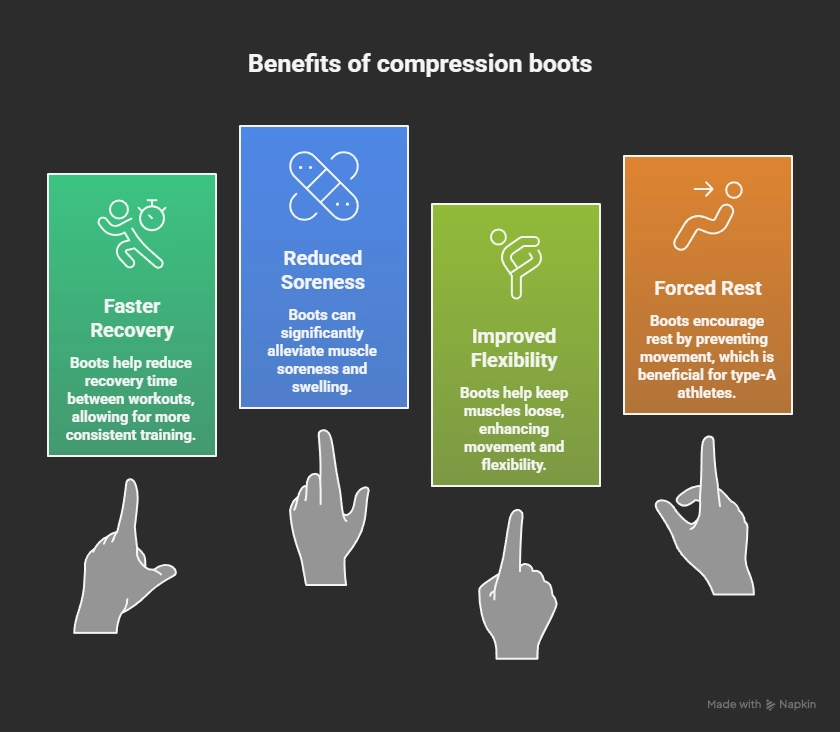
- You recover faster between workouts. When you’re running five or six days a week, every little edge counts. Boots help shrink that window where your legs feel flat, so your Tuesday session doesn’t suffer because of Sunday’s long run.
- Muscle soreness gets dialed down. We’re talking about DOMS – delayed onset muscle soreness – the kind that makes you grab the railing on every staircase for two days. Boots won’t make it vanish, but they take the edge off significantly. A study published on PubMed showed that pneumatic compression reduced perceived soreness and swelling in trained athletes.
- Your muscles stay looser. Loose muscles move better. That simple. This is especially useful if you’re pairing running with gym work or following a regular post-run stretching routine.
- You’re forced to actually rest. Here’s the sneaky benefit nobody talks about. Once you strap into these things, you literally can’t walk around. You sit. You breathe. You do nothing for 20-30 minutes. For type-A runners who feel guilty about resting, this built-in stillness is surprisingly valuable.
Key Features to Look For (The Compression Boots for Athletes Buying Guide)
Alright, let’s get into the stuff that’ll actually save you from buying the wrong pair. These are the specs and features worth paying attention to.
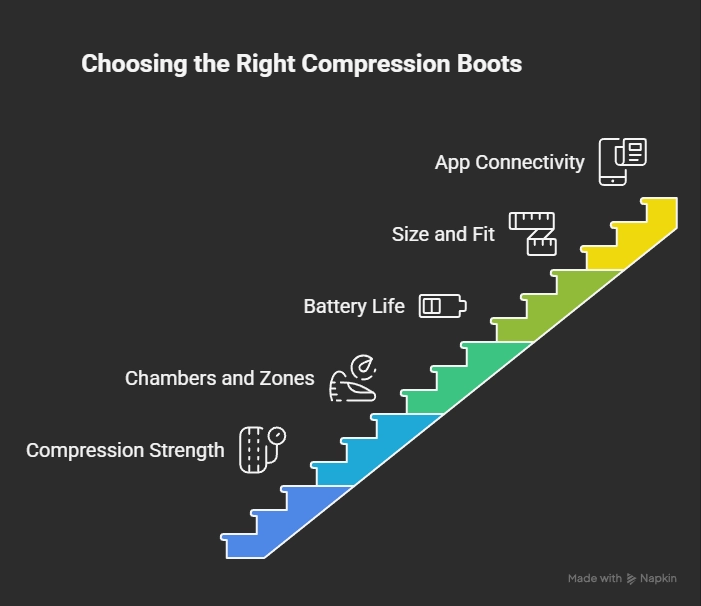
Compression Strength (Pressure Levels)
Pressure gets measured in mmHg – millimeters of mercury. All that means is how firmly the boot squeezes your leg. Higher number, stronger squeeze.
Most models sit somewhere between 20 mmHg and 110+ mmHg. On the low end, it feels like a gentle hug. Crank it up and it’s closer to someone really digging into your calves with their thumbs.
Here’s what I always tell people: get a pair with adjustable pressure. Your legs don’t feel the same every day. After an easy recovery jog, you might want something light. After a hilly 25K? You’ll want that deep squeeze.
Start somewhere around 40-60 mmHg if you’ve never used compression boots before. You can always go higher once you know what your legs respond to. There’s zero reason to max everything out on your first session.
Chambers and Zones
If you look inside a compression boot, you’ll see it’s divided into separate air pockets called chambers. Each one inflates on its own, one after another, creating that wave-like squeeze that moves blood upward.
More chambers generally means a smoother ride.
- 4 chambers: This is what you find in entry-level boots. The compression can feel a bit “jumpy” – like someone poking you in four spots instead of giving you a continuous squeeze.
- 5+ chambers: Much better transitions. Feels more like a rolling wave traveling up your leg. This is the standard in mid-range and pro-level units.
One term worth knowing: overlapping chambers. Some boots design their chambers so they slightly overlap with the one above. This eliminates “dead zones” – gaps between air pockets where fluid just sits there doing nothing. It’s a small detail that makes a real difference in how effective the session feels.
Battery Life and Portability
Where do you actually plan to use these boots? Your answer determines which type you need.
Plug-in models draw power from a wall outlet. They usually deliver stronger, more consistent compression. The trade-off is obvious – you’re tethered to wherever the nearest socket is. For home use, that’s totally fine.
Wireless or battery-powered models let you take them places. The gym, a hotel room the night before a race, the back of your car after a trail run. If portability matters to you, aim for at least 2-3 hours of battery life per charge. Less than that, and you’ll be charging more than compressing.
Here’s a real scenario I’ve seen play out: a friend traveled for a destination marathon, brought his plug-in boots, and then realized his Airbnb had outlets in weird spots that made using them awkward. A wireless pair would have solved that instantly. If you race in different cities, wireless is worth the extra cost.
Size and Fit
People spend 20 minutes comparing pressure specs and then completely ignore fit. That’s a mistake.
These boots are not one-size-fits-all. If the boot is too short, it won’t reach your upper thigh. Too loose, and you lose compression where you need it most. Either way, you’re not getting what you paid for.
Before ordering, pull out a tape measure and check the brand’s size chart. Most sizing goes by inseam length – the distance from your inner thigh down to your ankle. Some brands also factor in calf and thigh circumference.
Got bigger legs from years of running hills or doing squats? Some brands offer “wide” versions built for thicker calves and quads. Not every brand does, so check before you click “buy.”
App Connectivity and Customization
On one end, you’ve got compression boots for athletes with simple knobs and buttons on the control unit. On the other end, you’ve got Bluetooth-connected models with full smartphone apps.
Basic control units let you toggle pressure and pick from a handful of preset modes. Honestly? For most runners, that covers everything you need.
App-connected models let you build custom compression sequences, save favorites, and sometimes log your recovery sessions over time. Pretty cool if you’re a data nerd.
Where do I land on this? A great app attached to a mediocre boot is still a mediocre boot. Always prioritize compression quality, chamber design, and fit over software features. If the app comes as a bonus on a well-built pair, great. But don’t let it be the deciding factor.
Budget vs. Professional Compression Boots for Athletes: What Do You Really Get?
Money talk. Because let’s be real – price is a factor for most of us. Here’s what each tier typically offers.
Entry Level ($60 – $150)
Basic pressure controls, usually 4 chambers, almost always plug-in only. Build quality varies a lot at this price point. Do they work? Somewhat – you’ll notice improved circulation and your legs will feel a bit better after a session. For runners logging 15-25 miles a week recreationally, a budget pair is a reasonable place to start. Just don’t expect the polished experience of something three times the price.
Mid-Range ($300 – $600)
This is where things get genuinely good. For most serious recreational runners, this tier hits the sweet spot. You get overlapping chambers, wireless capability, a wider pressure range, and materials that won’t fall apart after six months. Brands in this range also tend to offer actual customer support and sell replacement parts – something you rarely see with budget models.
Pro Level ($800+)
Names like Normatec (by Hyperice) and Therabody RecoveryAir dominate here. Maximum pressure settings, granular customization through polished apps, and the kind of build quality that lasts for years of daily use. Worth it? If you train and compete seriously, probably. If you run three times a week for fun? You’re paying for features you won’t use.
What would I do? I’d go mid-range. You get about 90% of the performance at roughly half the cost of pro models. Take the money you save and invest it in proper shoes or a quality foam rolling setup.
Safety First: Who Should Avoid Compression Boots?
Compression Boots for Athletes are safe for the vast majority of healthy runners. But a few conditions make them a bad idea – and this part is worth reading carefully.
Do not use compression boots if you have:
- Deep vein thrombosis (DVT) or any history of blood clots. The squeezing action could potentially dislodge a clot. That’s a medical emergency you do not want.
- Open wounds, fresh stitches, or active skin infections anywhere on your legs.
- Severe varicose veins. Mild ones are generally fine, but if yours are pronounced, run it by your doctor first.
- A recent bone fracture or any active surgical site on your lower body.
- Nerve damage or chronic numbness in your legs or feet.
And a general rule: if something feels like real pain during a session – not just firm pressure, but sharp or burning pain – stop immediately and take the compression boots off. Compression should feel like a strong massage, never alarming.
If you’re currently working through a running injury, a quick conversation with your doctor or physio before buying is always smart.
Frequently Asked Questions
Do compression boots for athletes actually work for runners?
They do – and the evidence backs it up. Research shows they help flush metabolic waste from tired muscles, reduce soreness after hard efforts, and improve blood flow to speed up repair. A study published on PubMed confirmed reduced swelling and fatigue in athletes using pneumatic compression post-exercise. They’re not a replacement for sleep and good food, but they’re a genuinely useful addition.
How long should I sit in compression boots for athletes?
Stick to 20-30 minutes per session. That’s the range most manufacturers and sports therapists suggest. Going longer doesn’t necessarily speed things up. And if your legs start feeling numb or tingly at any point, lower the pressure right away or end the session.
When is the best time to use recovery boots?
After your run is the ideal window – within a couple of hours of finishing if possible. That’s when your legs have the most waste to clear out. Some runners also do a quick 10-15 minute session before a run to get blood moving and “wake up” heavy legs. I’ve tried both and honestly, the post-run session makes the bigger difference.
Can I use compression boots every day?
Most runners do, especially during intense training phases, and that’s perfectly fine. Just pay attention to how your body responds. If you start noticing bruising, skin irritation, or unusual soreness, dial it back for a day or two. Daily use is fine – but forced daily use when your body says otherwise isn’t.
Are cheap compression boots worth it?
Honestly? For some runners, yes. Budget boots still push air through chambers and move blood around. You’ll definitely notice the difference compared to doing nothing. What you lose is smooth massage transitions, battery life, and how long the thing lasts before something breaks. If you run a few times a week casually, an affordable pair might be all you ever need. If you’re deep into structured training, plan on upgrading eventually.
Wrapping It Up
Picking the right compression boots for athletes doesn’t need to be complicated. Nail the fit first. Then look at adjustable pressure, chamber count, and whether you need a battery-powered unit or not. Everything else is a bonus.
You don’t need the flashiest, most expensive pair on the market. A solid mid-range option will serve most runners well for years – and your legs will thank you after every hard session.
Take care of your legs. They’re the ones doing all the work out there.