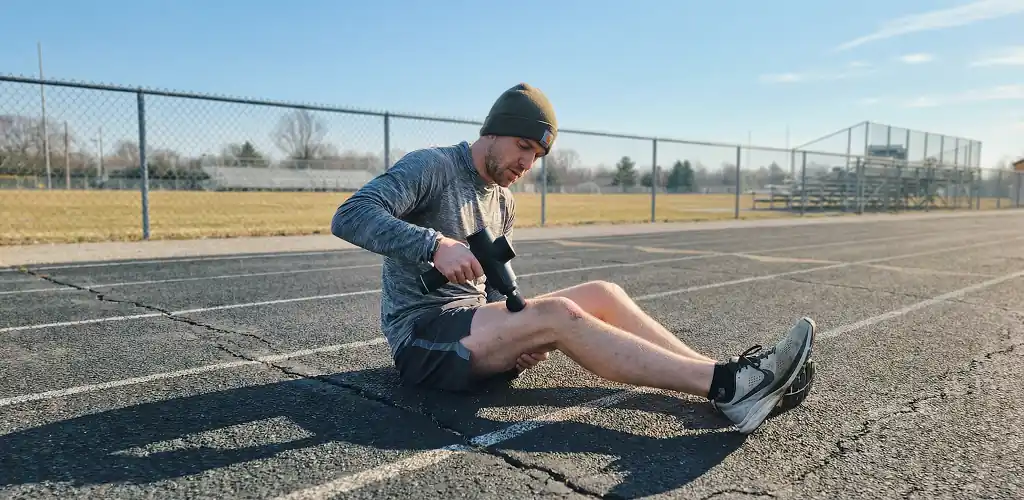
Most runners discover gun massage benefits the hard way – after hobbling around for two days with legs that refuse to cooperate. I’ve been there. You probably have too.
You crushed a solid long run. Pace felt great, breathing was controlled, and everything just worked. Then you woke up the next morning. Your quads screamed. Your calves turned into concrete blocks. Even walking downstairs felt like an Olympic event.
Sound familiar? Yeah, it’s the worst part of the sport.
Here’s the thing though. Recovery doesn’t have to hurt this much. A simple massage gun can seriously change how your body bounces back. It sends rapid pulses deep into tired muscle tissue. It helps flush out waste, boosts blood flow, and gets your legs ready to run again sooner.
No expensive sports therapist needed. No awkward foam rolling sessions where you’re basically planking while trying to relax. Just a handheld device and ten minutes on the couch.
Let me walk you through seven honest, evidence-backed reasons why percussive therapy deserves a spot in your running recovery gear lineup.
What Is Percussive Therapy, Anyway?
If you’ve never used one, a massage gun looks a bit like a power drill. Don’t worry, it’s much friendlier than that.
Percussive therapy uses a handheld device that delivers rapid bursts of pressure into muscle tissue. Unlike a regular hand massage that mostly stays on the surface, a massage gun reaches up to 16mm deep into the soft tissue. That depth is where the real tension hides.
Most models punch out between 1,800 and 3,200 percussions per minute. Those mechanical vibrations stimulate blood flow, loosen tight fibers, and calm your nervous system after a hard effort.
Think of it as having a really persistent sports therapist who never gets tired and never charges by the hour.
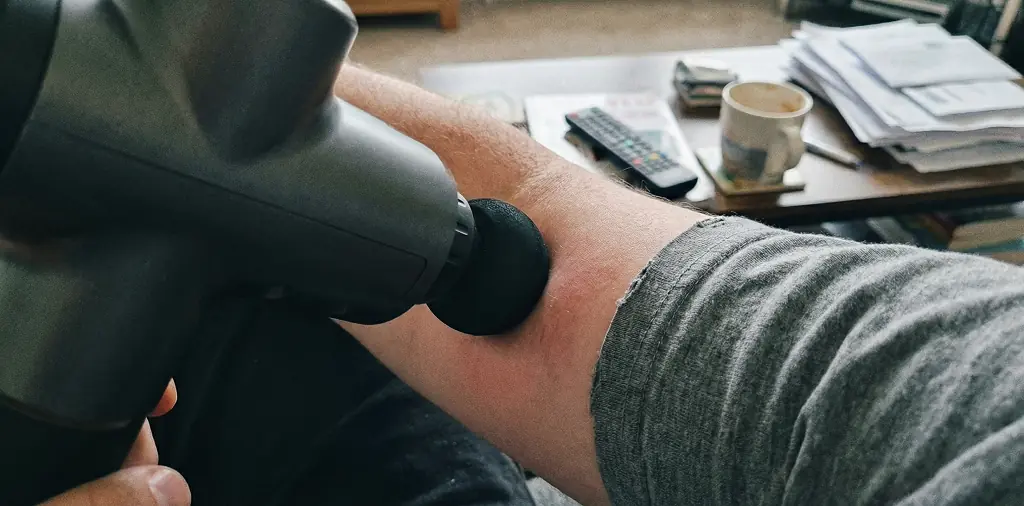
7 Proven Gun Massage Benefits That Actually Matter for Runners
1. Speeds Up Muscle Recovery Through Better Blood Flow
Every time you run, your muscles absorb thousands of impacts. All those contractions create tiny micro-tears in the muscle fibers. Totally normal. That’s literally how muscles grow stronger.
But repair needs raw materials. Oxygen. Nutrients. And blood delivers both.
A massage gun cranks up local blood circulation right where you point it. More blood flowing to your quads means faster oxygen delivery. Faster oxygen means faster repair. It’s honestly that straightforward.
I like to think of it this way. After a hard tempo run, your legs are a construction zone. Blood is the delivery truck hauling in building materials. A massage gun makes those trucks move faster.
A 2023 study showed percussive therapy at 38-47 Hz significantly increased blood flow vs. control. It boosted popliteal artery volume flow and velocity compared to just sitting around.
2. Takes the Edge Off DOMS
DOMS stands for Delayed Onset Muscle Soreness. It’s that deep, achy pain peaking 24-48 hours after tough workouts from micro-tear inflammation. Not leftover lactic acid, which clears in 30 min.
One of the most noticeable gun massage benefits is how much it shortens the DOMS window.
I have a running buddy who used to write off two full days after every long run. Her legs got so stiff she could barely shuffle to the kitchen. She started spending ten minutes with a massage gun right after finishing. Focused on quads and calves. Nothing fancy.
Within a few weeks, her recovery window shrank from 48 hours to roughly 24. She didn’t change anything else. Same mileage, same shoes, same sleep schedule. The gun was the only new variable.
That’s the kind of real-world shift percussive therapy for runners can create. Not magic. Just consistent maintenance.
3. Loosens You Up for a Better Range of Motion
Tight muscles shorten your stride. When hip flexors, hamstrings, or calves lock up after hard training, your running form quietly falls apart. Over months, a restricted range of motion sneaks up on you. Then one day your physio asks why your hip mobility is so limited.
A massage gun helps release tension in the fascia – that connective tissue wrapping everything together. When fascia stiffens, your muscles lose their ability to move freely.
Study from the Journal of Sports Science & Medicine found percussive therapy improves short-term hamstring ROM (+11.4%) vs. rest (-3.6%), comparable to stretching by reducing stiffness.”
If you can’t touch your toes after a run (no judgment, I’ve been there plenty), try two minutes of gun work on your hamstrings. Honestly, it often works better than holding a static stretch and counting to thirty.
4. Breaks Up Scar Tissue and Stubborn Knots
Years of running create adhesions in your muscle fibers. These are sticky spots where tissue layers bond together. You know those tight knots buried deep in your calves? Or that one persistent sore point along your IT band that never fully goes away?
Those are adhesions. And they’re annoying.
A massage gun acts like a precision tool to separate stuck fibers. The rapid percussions restore normal tissue sliding and movement.
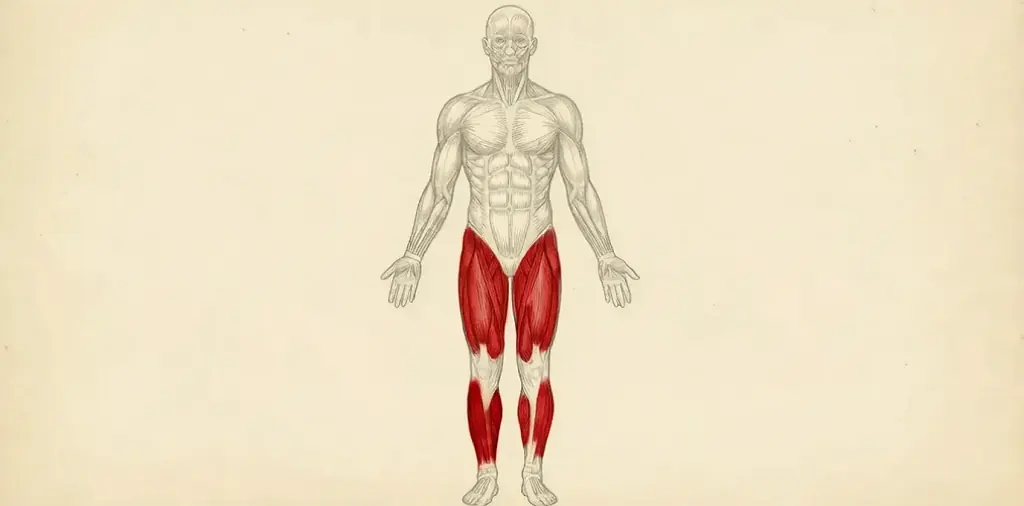
This is where the massage gun vs foam roller question gets interesting. A foam roller does a decent job on large surface areas. But try to zero in on one specific knot with a foam roller. Good luck. The massage gun lets you go after exactly where the problem lives.
Imagine a sports therapist pressing into a knot with their elbow. A massage gun does something very similar. Minus the appointment scheduling. Minus the around $80 bill.
5. Makes Your Warm-Up Actually Effective
Here’s something most runners overlook. A massage gun isn’t just a recovery tool. It’s a solid warm-up companion. Gun massage benefits can thus be shown even before a run.
Spending 30 seconds per muscle group before your run stimulates the nervous system and pushes blood into cold muscles. Your legs wake up faster. You feel responsive from the very first stride instead of spending the first mile or km feeling sluggish.
I started doing this about a year ago and noticed a difference almost immediately. Quick hits on quads, hamstrings, calves, and glutes. Maybe two minutes total. Then I do my usual dynamic stretches. The first kilometer just felt… easier. Like my legs already knew what was coming.
Pro tip: Use the round ball attachment and keep the gun floating across the surface. Don’t press hard during activation. You want stimulation, not a deep-tissue session before you’ve even started running.
6. Delivers Quick Pain Relief
Ever whack your shin on a coffee table and instinctively rub it? That rubbing actually does something useful. And there’s a proper scientific explanation.
The Gate Control Theory of Pain says your nervous system can only handle so many signals at once. When a massage gun floods the area with strong vibration signals, it essentially drowns out the pain messages heading to your brain.
It won’t fix what’s causing the pain. Let’s be honest about that. But it provides fast, noticeable relief when you need it most.
After a brutal interval session, 60 seconds of gun work on screaming calves can make walking feel normal again. That immediate comfort alone makes it worth keeping in your bag.
7. Saves You Real Money Over Time
When we talk about gun massage benefits, we must not forget about money. Let’s do some quick math. A quality sports massage runs between $60 and $120 per session depending on where you live. Go weekly – which serious runners probably should – and you’re looking at $3,000 to $6,000 per year.
A solid massage gun costs between $100 and $400. Once. That’s it. It doesn’t cancel on you. It doesn’t have limited hours. And you can use it at 10 PM on a Sunday in your sweatpants.
Now look, a massage gun won’t replace a skilled therapist for complex injuries. If something feels genuinely wrong, go see a professional. But for everyday maintenance and reducing muscle soreness after training runs? The economics aren’t even close.
Throw it in your gym bag. Leave it in the car for post-race recovery. Keep it next to the couch. Recovery happens whenever and wherever you need it.
Gun Massage Benefits vs Foam Roller Benefits: An Honest Comparison
This debate comes up constantly. And the honest answer won’t satisfy people who want a clean winner.
They solve different problems.
Foam rollers work well on large, broad muscle groups. Rolling out your quads or IT band covers a lot of real estate quickly. They’re also cheap. Twenty to thirty bucks gets you a good one.
But foam rolling has genuine downsides that people don’t talk about enough. It’s physically exhausting. You’re holding yourself in uncomfortable positions while trying to relax your muscles. Try foam rolling your calves after a 20-mile run. Your arms will quit before your calves loosen up. It also struggles with smaller, deeper muscles like the tibialis anterior.
Massage guns win on precision and effort. Point it at a trigger point, adjust the speed, and let the device do the work. Your only job is holding it. That matters more than you’d think when you’re completely wiped after a long run.
My honest recommendation? Own both if you can. Foam roller for broad pre-run prep. Massage gun for post-run targeted recovery and those stubborn knots that won’t let go.
But if your budget allows only one? The massage gun. The convenience and depth of treatment make it the smarter investment for most runners.
How to Actually Get All Gun Massage Benefits (Use a Massage Gun for Running)
Buying one is the easy part. Using it correctly is where people trip up. Here’s a straightforward framework I’ve refined over time.
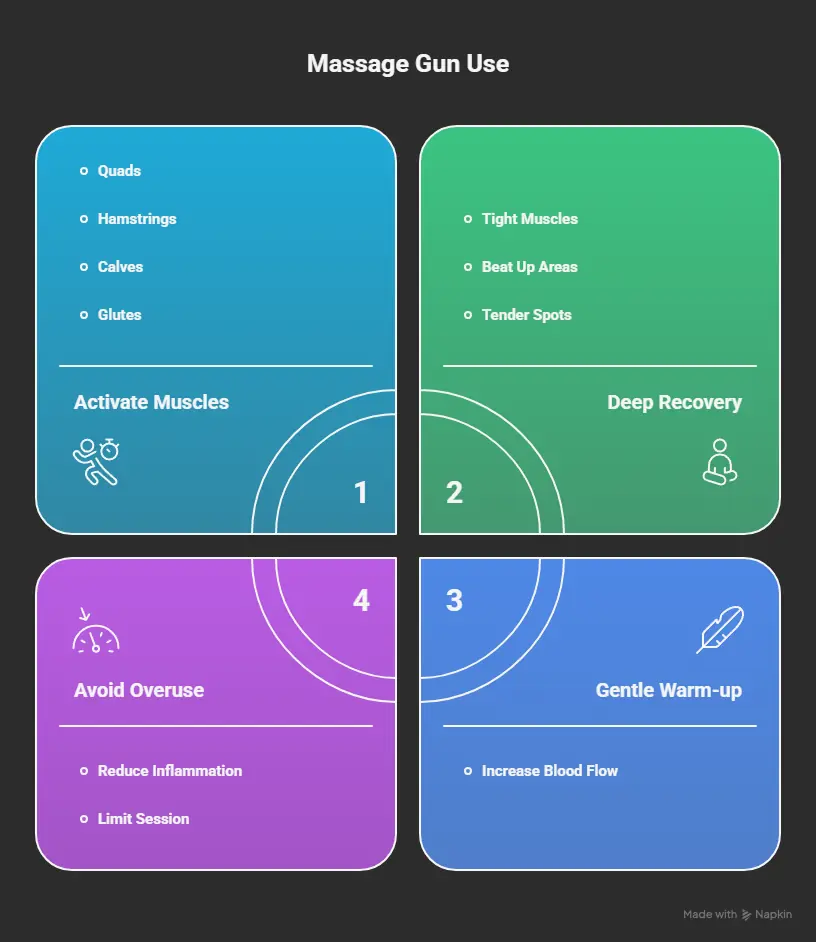
Pre-Run Routine (Muscle Activation)
The goal here is waking muscles up. Not breaking them down.
- Speed: High (fast percussions)
- Pressure: Light. Let the gun glide across the surface.
- Time: 30 seconds per muscle group
- Target areas: Quads, hamstrings, calves, glutes
Keep the gun moving steadily. Don’t park it in one spot. You want to increase blood flow and tell your nervous system it’s time to work.
Post-Run Routine (Deep Recovery)
After your run, slow everything down. Be more intentional.
- Speed: Low to medium
- Pressure: Moderate. Press into the muscle, but back off if you feel anything sharp.
- Time: 1 to 2 minutes per muscle group
- Target areas: Whatever feels tight or beat up
When you find a tender spot, linger there. Give it a few extra seconds. But never go beyond 15 minutes total per session. More isn’t better here. Overdoing it can actually increase inflammation. I learned that one the hard way.
A Quick Word on Safety
Keep the gun away from:
- Bones and joints (knees, shins, ankle bones)
- Open wounds or fresh bruises
- The front and sides of your neck
- Directly on the spine
If you’re dealing with an existing injury, check with a physiotherapist first. Massage guns pack real force. Using them wrong on certain conditions can make things worse instead of better.
What to Look for When Buying a Massage Gun
Not all massage guns perform the same. Some are genuinely excellent. Others are glorified vibrating toys. Here are the specs that actually matter for runners.
Stall Force (30 lbs minimum)
Stall force measures how hard you can push the gun into your body before the motor stalls out. Leg muscles are dense, especially quads and glutes. Anything below 30 lbs of stall force will feel weak and disappointing on those areas.
Amplitude (12mm or more)
Amplitude is how deep the massage head travels with each stroke. Higher amplitude equals deeper penetration. Aim for at least 12mm. Devices under 10mm feel buzzy on the surface. They vibrate your skin without really reaching the tissue underneath.
Battery Life
If you travel for races or bring the gun to the gym, battery life matters. Most quality models deliver 2 to 4 hours per charge. Anything less gets annoying fast, especially if you forget to charge it the night before a race.
Noise Level
Some massage guns sound like you’re renovating your bathroom. If you want to use yours while watching TV or in a shared hotel room before a race, look for models under 60 decibels. Several brands now make near-silent options. Your partner will thank you.
Frequently Asked Questions About Gun Massage Benefits
Is a massage gun good for runners?
Absolutely. There are proven gun massage benefits. A massage gun helps reduce soreness, improve flexibility, and speed recovery by driving more blood into fatigued muscles. For the price, it’s one of the most practical recovery tools a runner can own.
When should I use a massage gun for running?
Both before and after. Use it before a run for 30 seconds per muscle group to warm up and activate your legs. Use it after a run for 1 to 2 minutes per muscle group to ease tension and soften the blow of DOMS.
Can I use a massage gun on shin splints?
Carefully. Never apply the gun directly to the shin bone itself. Target the muscle running alongside it – the tibialis anterior. Use light pressure on a slow speed. If the pain sticks around, get it checked by a professional.
How long should you massage your legs with a massage gun after running?
Spend 1 to 2 minutes per muscle group. Cover your quads, hamstrings, calves, and glutes. Keep total session time under 15 minutes. Going longer doesn’t produce better results. It just irritates the tissue.
Does percussive therapy actually work?
It does. Multiple studies confirm that percussive therapy effectively reduces DOMS severity and improves short-term range of motion.
Gun Massage Benefits – Conclusion
The gun massage benefits we’ve covered here aren’t about luxury or trendy fitness gadgets. They add up to something practical. Faster recovery. Less soreness. Better mobility. More effective warm-ups. Over weeks and months of consistent training, these small improvements stack on top of each other.
Whether you’re training for your first 5K or grinding toward a marathon PR, a massage gun earns its place quickly. It won’t replace sleep, nutrition, or rest days. Nothing replaces those. But it fills a daily maintenance gap that stretching and foam rolling alone can’t quite cover.
Every runner I know who commits to percussive therapy says some version of the same thing. “Why didn’t I start this sooner?”
Don’t be that person a year from now.