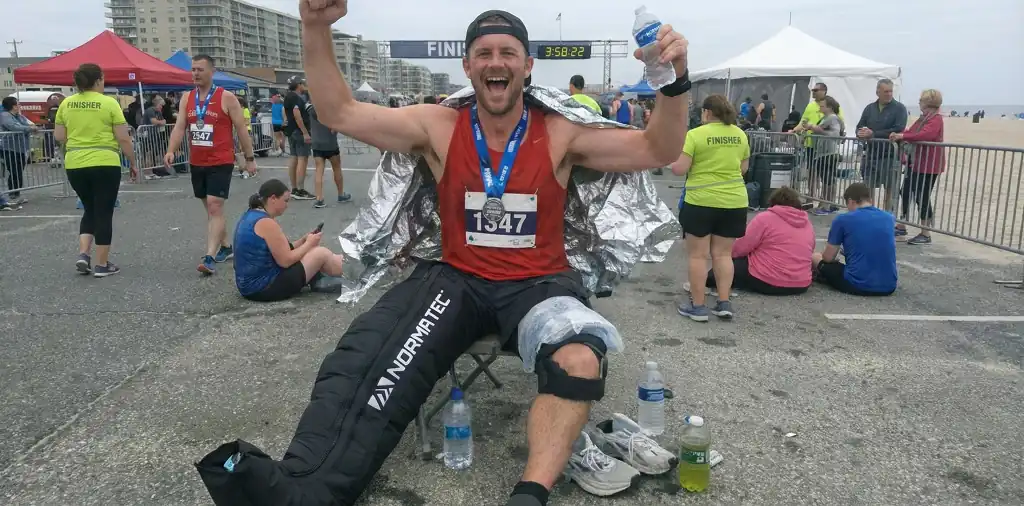
You crossed the finish line. The medal is around your neck. Someone’s taking photos and you’re doing your best to look like you’re not dying inside.
Then you try to walk to the car.
That stiff, slightly sideways shuffle kicks in almost immediately. Stairs suddenly feel like mountaineering. Sitting down on the toilet becomes a tactical operation you have to mentally prepare for. At that point, marathon recovery feels way more important than whatever time you clocked.
Muscle soreness after a marathon is no joke. And when your quads feel like they’ve been replaced with concrete blocks, you’ll genuinely consider buying anything that promises relief.
But here’s what I’ve learned: you really don’t need to spend a fortune to recover well. Some of the pricier tools out there feel absolutely amazing – I won’t pretend otherwise – but plenty of cheap alternatives do a surprisingly similar job. Whether you’ve got $20 to spare or $2,000 burning a hole in your pocket, this guide should help you figure out what’s actually worth your money.
Why Do You Hurt So Much? (Understanding the Damage)
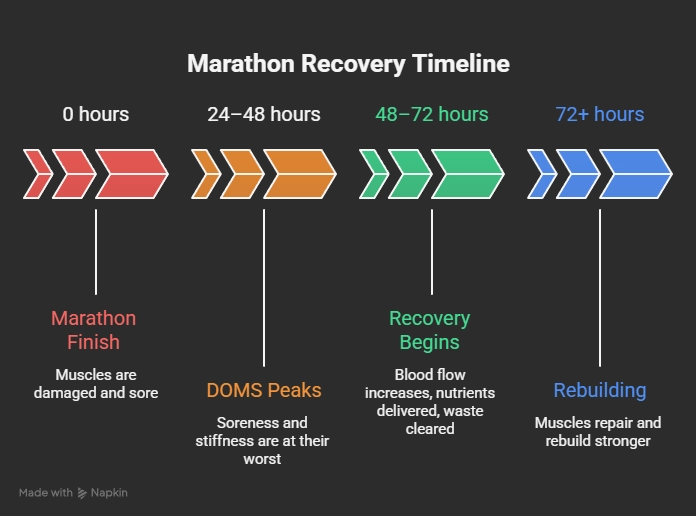
After 26 miles (42 km), your muscles aren’t just “tired.” They’re genuinely damaged – and that’s actually by design.
That soreness that peaks around 24-48 hours later has a name: DOMS (Delayed Onset Muscle Soreness). It happens because of tiny micro-tears in your muscle fibers. Sounds scary, but it’s completely normal. It’s basically your body’s way of breaking things down so they can rebuild stronger.
And no, despite what you might have heard years ago, it’s not caused by lactic acid sitting in your muscles. That stuff clears out within hours of finishing.
So what’s all the recovery gear actually doing?
Pretty much every tool out there (foam rollers, massage guns, those fancy compression boots) is trying to do one main thing: get more blood flowing through your muscles. And better blood flow helps with a few important things:
- Delivering the nutrients your muscles need to repair themselves
- Bringing down swelling and inflammation
- Clearing out metabolic waste products
- Loosening up stiffness
That’s really the whole game. Move blood around, keep inflammation in check, give your muscles what they need to fix themselves.
With that in mind, let’s look at what’s actually out there.
Massage Tools for Marathon Recovery: The Battle of Pressure
This is the category where the price gap is widest and the debate is loudest. Let’s put both options side by side.
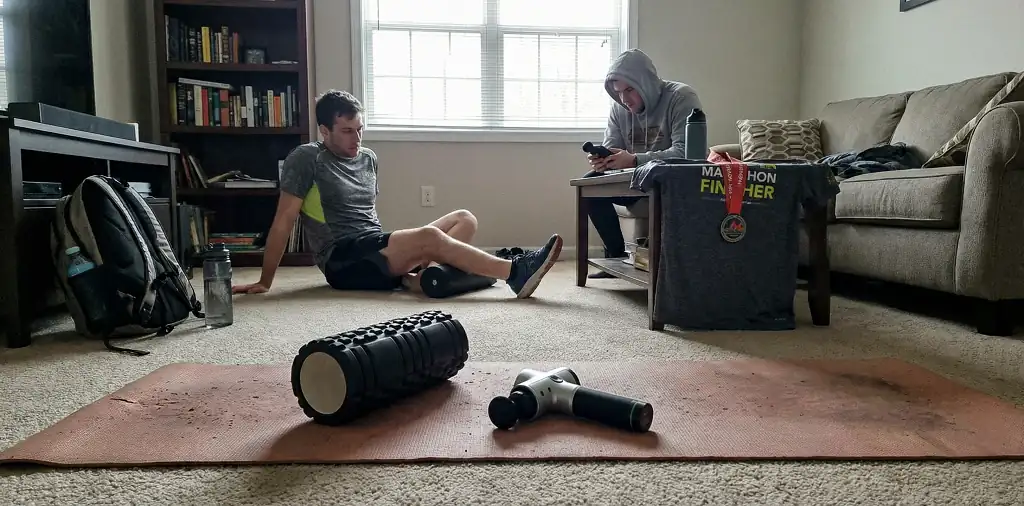
The Budget Option: Foam Rollers & Lacrosse Balls ($10-$40)
The humble foam roller. It’s been around forever and there’s a reason it’s still in every runner’s living room.
Pros:
- Dirt cheap and basically indestructible
- Really effective for deep tissue work
- Works great on the big muscle groups – quads, hamstrings, calves
- No charging, no syncing, no apps to deal with
Cons:
- It hurts. Like, really hurts – especially the day after a marathon
- You’re basically holding yourself up while rolling, which takes effort when you’re already wrecked
- Some spots on your body are just really awkward to reach
I’ve seen plenty of first-time marathoners attempt to foam roll their quads the morning after a race. It’s never pretty to watch. Lots of grimacing, some creative swearing. But honestly, it does the job.
A lacrosse ball is a nice addition for more targeted work. Rolling it under your glutes when they’re locked up is brutal, but in that satisfying “hurts so good” kind of way.
The Pro Option: Percussive Massage Guns ($200-$600)
Massage guns work through percussion therapy – basically rapid-fire pulses that hammer into the muscle tissue.
Pros:
- Almost zero effort required (just hold it and move it around)
- Gets deep into the muscle layers
- You can feel the blood flow improving almost right away
- Feels really, really good
Cons:
- Not cheap, especially the good ones
- Battery life can be hit or miss depending on the model
- The heavier ones will tire out your arm, which is ironic
The convenience factor is hard to argue with. You can literally sit on the couch watching Netflix and let the thing do its work.
The Verdict: Do You Need It?
For recovery after a marathon, a foam roller honestly gets the job done.
A massage gun is more of a convenience upgrade than a necessity. It makes the whole process more comfortable and less of a chore, but it’s not going to magically knit your muscle fibers back together any faster than putting in consistent work with a roller.
If money’s tight: just get the foam roller. Seriously.
If you hate getting on the floor and doing the whole rolling routine: the massage gun is probably worth the investment for you.
Squeeze the Soreness Away: Compression
The Budget Option: Compression Socks ($20-$50)
Compression socks apply a steady, graduated pressure to your lower legs.
What they actually do:
They help keep blood from pooling down in your calves and ankles. This is especially handy right after a long race, or if you’ve got a flight home afterward.
Best for:
- Wearing to work the day after (nobody will even notice)
- Traveling home post-race
- Dealing with mild swelling
They’re low-key, practical, and you just pull them on and forget about them.
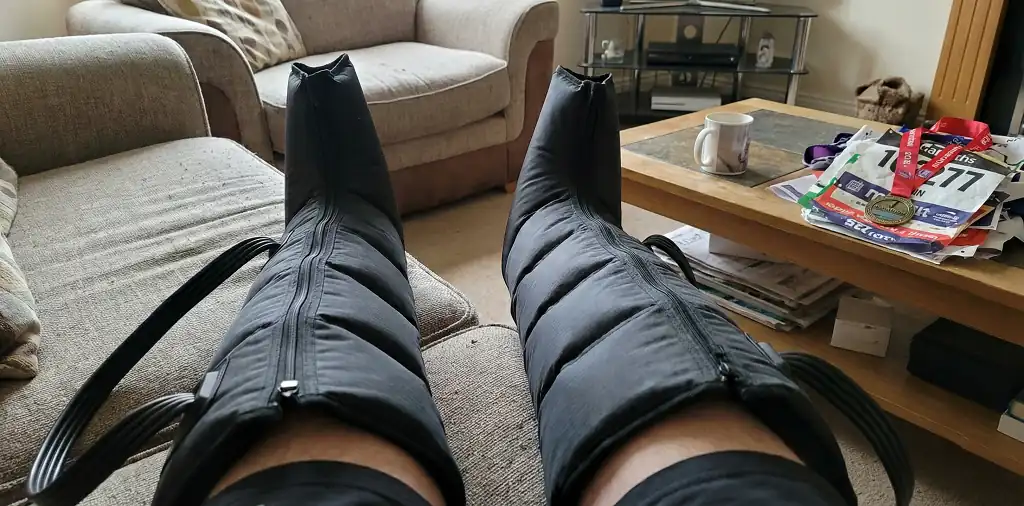
The Pro Option: Pneumatic Compression Boots ($600+)
These are the NormaTec-style boots you’ve probably seen all over Instagram.
They work through pneumatic compression – air chambers built into the boots inflate and deflate in sequence, actively pushing fluid up and out of your legs.
What they do:
- Feel like a really thorough leg massage
- Actively move lymphatic fluid around
- Take away that heavy, waterlogged feeling in your legs
Best for:
- Periods of really intense training
- When you’re racing on back-to-back weekends
- Sitting on the couch pretending you’re in a spa
I’ll be honest, they feel absolutely incredible. It’s like having a very patient robot slowly squeeze your legs back to life.
The Verdict: Is It Worth It?
Compression boots are impressive pieces of kit, no question. But for the vast majority of runners (I’d say 90% or more) compression socks handle things just fine.
The boots are really about added comfort and convenience. If you’re someone who races several times a year or trains at a pretty high level consistently, sure, they start to make sense. But if you run one marathon a year? Socks are more than enough.
(For what it’s worth, research from places like Runner’s World and various studies on PubMed suggest compression may help reduce how sore you feel but the actual measurable effect is pretty modest.)
Hot & Cold Marathon Recovery: Ice Baths vs. Cryotherapy
The Budget Option: DIY Ice Bath & Epsom Salts ($5)
Fill your bathtub. Dump in a bag of ice from the gas station. Lower yourself in and try to stay there for 10-15 minutes.
Is it comfortable? Absolutely not. But it can knock inflammation down pretty quickly.
As for Epsom salts – they’re not going to “detox” you or anything like that, despite what the packaging implies. But a warm bath with them in it can genuinely help relax tight muscles and get some circulation going.
Nothing fancy. It just works.
The Pro Option: Cryotherapy Chamber ($60/session)
You step into a chamber cooled to subzero temperatures and stand there for about 2-3 minutes.
What people claim:
- A strong anti-inflammatory response
- Noticeably reduced soreness
- A mood boost from the adrenaline hit
It’s intense, I’ll give it that. And some runners absolutely swear by it.
The Verdict: Best Bang for Your Buck
The research on cold therapy is honestly pretty mixed. A lot of studies show that a plain old ice bath at home does roughly as much good as an expensive cryotherapy session.
If what you’re after is inflammation control during marathon recovery, your bathtub and a $3 bag of ice will get you there.
Quick Look: Budget vs. Pro Gear Cost Analysis
| Gear Type | Budget Item | Pro Item | Winner for Value |
|---|---|---|---|
| Massage | Foam Roller ($20) | Massage Gun ($300) | Foam Roller |
| Compression | Socks ($30) | Compression Boots ($800) | Socks |
| Cold Therapy | Ice Bath ($5) | Cryotherapy ($60/session) | Ice Bath |
| Total Setup | ~$55 | $1,500+ | Budget Setup |
The takeaway here is pretty clear: you can put together an effective marathon recovery kit for less than sixty bucks.
The Best Marathon Recovery Tools Are Free
Here’s what actually makes the biggest difference and none of it costs a thing.
1. Sleep
This is the big one. Deep sleep is when your body releases ~70% of its daily HGH, and that’s when the real muscle repair happens.
You can own every recovery gadget on the market, but if you’re only sleeping five hours a night, none of it matters much.
2. Hydration
Get fluids and electrolytes back in. Your muscles literally cannot repair themselves properly without adequate hydration at the cellular level. It sounds basic because it is, but a lot of people overlook it.
3. Active Recovery
Go for an easy walk. Spin gently on a bike. Maybe a relaxed swim if you can manage it.
Studies show low-intensity movement (e.g., EMS) reduces arterial stiffness by ~8-14% via boosted local blood flow, but no evidence 24-hour sitting post-marathon worsens soreness (rest usually helps).
4. Smart Nutrition
Carbs to refill your glycogen stores. Protein to repair the muscle damage.
And if you suspect your shoes played a role in creating extra muscle strain, it might be worth taking a fresh look at your running shoes situation too.
When it comes to effective post marathon recovery, sleep and solid nutrition will outperform any gadget, every single time.
FAQs About Marathon Recovery
How long does it take to fully recover from a marathon?
For most people, the worst of the soreness fades within 5-7 days. But full muscular and cellular repair can take anywhere from 2 to 4 weeks, depending on how trained you are and how hard you pushed on race day.
Should I run the day after a marathon?
Don’t do any hard running, no. Walking, easy swimming, or gentle cycling are much better options – they get blood moving without putting impact stress on joints that have already taken a beating. Give your body a break.
Do massage guns actually help marathon recovery?
They do help, yes. They improve circulation and can reduce that locked-up stiffness feeling. But they don’t directly “heal” the micro-tears in your muscles. Think of them as a tool for comfort and better blood flow and not some kind of miracle fix.
What should I eat for post marathon recovery?
Focus on:
- Carbohydrates to get your glycogen stores back up
- 20-40g of protein for muscle repair
- Fluids with electrolytes to rehydrate
You don’t need to overthink it. Rice, eggs, salmon, potatoes, fruit, yogurt – simple meals built around those kinds of foods will do the trick.
Conclusion
You really don’t need a garage full of expensive gadgets for effective marathon recovery.
A foam roller. A decent pair of compression socks. A bag of ice and a bathtub. Good sleep.
That honestly covers the fundamentals.
The fancier stuff like massage guns, compression boots, cryotherapy sessions is mostly about convenience and comfort. It feels great and it saves you some time and effort. But there’s nothing magical about any of it.
If I were putting together a recovery kit starting from zero? I’d go budget first and only add the premium upgrades if I found myself training hard throughout the year and wanting that extra ease. For most people, the basics are more than enough.