
A good foam roller for sore legs can take the edge off that post-run stiffness and help your muscles bounce back quicker. You know that feeling when you finish a long run, sit down for twenty minutes, and then try to stand up? Your calves lock up. Your quads protest every step. Walking downstairs suddenly requires actual concentration. Most runners know this feeling way too well.
The tricky part? Walk into any sporting goods store or scroll through Amazon, and you’ll find dozens of options. Different shapes, textures, densities, price points. It gets confusing fast. This guide walks you through all of it – how foam rollers actually work, which type makes sense for your situation, how to use one without making things worse, and what to look for when you’re ready to buy.
What Is the Best Foam Roller for Sore Legs?
A medium-density, smooth foam roller between 18 and 24 inches long is the sweet spot for most runners. It pushes back firmly enough to reach tight calves, quads, and hamstrings, but it won’t leave you wincing on the living room floor. If you only buy one roller and want it to cover most situations, this is the type to grab.
Best Choice for Most Runners
I always tell runners who ask me: start in the middle. A medium-density smooth roller handles about 80% of what recreational and competitive runners need. The smooth surface spreads pressure across the whole muscle instead of digging into one tiny spot. That matters a lot when your legs are already angry from a hard session.
Mid-length rollers (18-24 inches) give you enough surface to roll quads and hamstrings comfortably. They’re also small enough to lean against a wall or toss in a closet. Nothing fancy, nothing complicated. Just a solid tool that does its job.
If you end up wanting something firmer or more textured down the road, great. But as a starting point, medium-density and smooth is hard to beat.
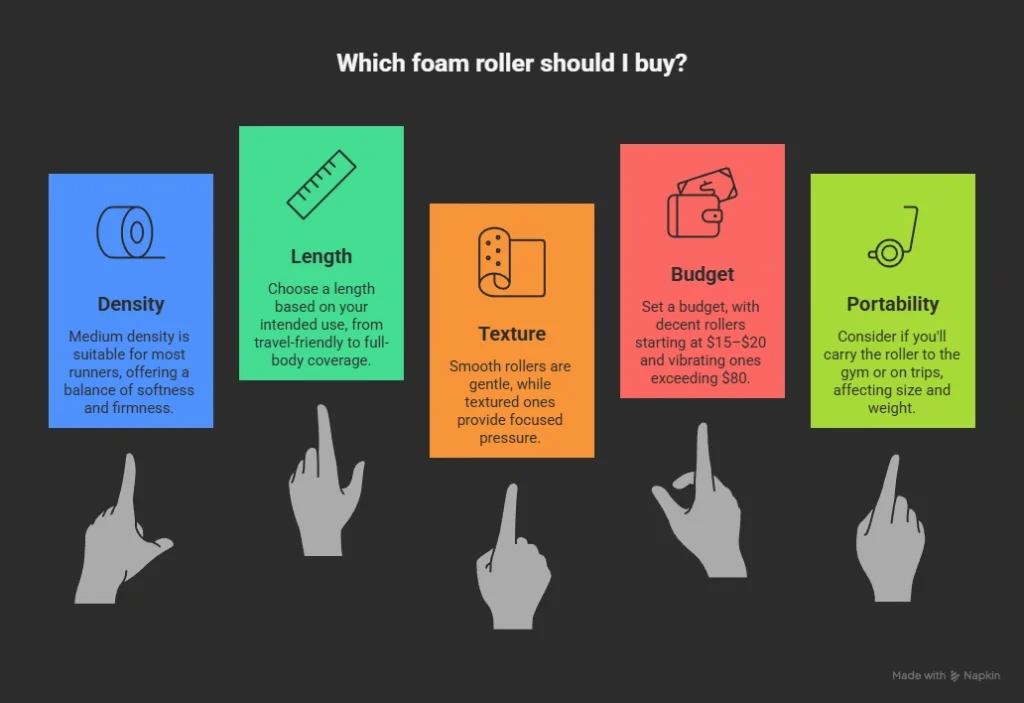
Quick Buying Checklist
Here’s what to check before you hand over your money:
- Density: Soft, medium, or firm. Medium fits most runners.
- Length: 12 inches for travel, 18-24 inches for home use, 36 inches if you want full-body coverage.
- Texture: Smooth feels gentler. Textured creates more focused pressure points.
- Budget: Decent rollers start around $15-$20. Fancy vibrating ones push past $80.
- Portability: Will you carry it to the gym? Take it on trips? Size and weight matter here.
Foam Roller Comparison Table
| Roller Type | Best For | Pressure Level | Pros | Cons | Price Range |
|---|---|---|---|---|---|
| Smooth, medium density | Most runners | Moderate | Even pressure, beginner-friendly, affordable | Less targeted than textured options | $15-$35 |
| Textured, medium density | Deeper muscle work | Moderate to high | Targets specific tight spots | Can feel rough on very sore muscles | $25-$50 |
| Soft density | Beginners, sensitive legs | Low to moderate | Gentle, minimal bruising risk | May feel like it’s barely doing anything for experienced runners | $10-$25 |
| Firm density | Experienced runners | High | Deep pressure, very durable | Uncomfortable on really sore days | $20-$45 |
| Vibrating | Users wanting extra features | Adjustable | Multiple intensity settings, soothing sensation | Pricey, needs regular charging | $60-$150 |
Why Runners Get Sore Legs After Running
It helps to understand what’s actually happening inside your legs before you start trying to fix it. Soreness after running isn’t random. There are real reasons behind it.
Normal Soreness After a Run
When you run hard, you create tiny micro-tears in your muscle fibers. That sounds alarming, but it’s actually a normal part of getting stronger. Your body patches those tears up, and the process itself causes that stiff, achy feeling most runners recognize.
This is called delayed onset muscle soreness, or DOMS for short. It typically kicks in 12 to 48 hours after a tough effort. That’s why your legs might feel okay right after a tempo run but absolutely terrible the next morning.
The usual culprits? Speedwork, hill repeats, your first long run in a while, or jumping back into training after time off. Basically, anything your muscles aren’t fully prepared for.
Tight Spots Runners Feel Most
Every runner has their own sore spots, but certain areas come up over and over:
- Calves: They take a beating during push-off, especially on hills.
- Quads: These absorb most of the impact when you run downhill or on hard surfaces.
- Hamstrings: They work harder as your pace increases or your stride gets longer.
- Glutes: They stabilize your pelvis with literally every single step.
- Outer hip (IT band area): This zone tightens up notoriously during high-mileage weeks.
All five areas respond really well to foam rolling. That’s not a coincidence – they’re the biggest workhorses in a runner’s body.
Normal Soreness vs Injury Warning Signs
Here’s where a lot of runners get tripped up. Not every ache means the same thing, and knowing the difference can save you weeks of lost training.
Normal soreness feels dull, spread out, and roughly equal in both legs. It fades on its own within a couple of days. You can still function – it just doesn’t feel great.
Injury warning signs look different. Sharp pain concentrated in one specific spot. Swelling you can actually see. Bruising that appeared without bumping into anything. Limping. Numbness or tingling. Any pain that hangs around for more than a week or gets worse instead of better.
A foam roller for sore legs helps with general tightness. It does not fix injuries. If something feels genuinely wrong, put the roller down and go see someone who can properly evaluate what’s happening.
More on how to identify running-related injuries can be found here.
How a Foam Roller Helps Sore Legs
So what actually happens when you lie on a cylinder of foam and slowly roll back and forth? More than you might think.
Helps Muscles Relax and Move Better
Foam rolling works like giving yourself a massage. Your body weight exerts pressure on the roller, which signals tight muscles to relax. After a few minutes, that “locked up” sensation most runners feel in their legs starts to melt away.
I like to compare it to kneading stiff dough. You don’t punch it – you press steadily, work through the tough spots, and let the pressure do the work. Slow, consistent rolling loosens things up far better than frantic back-and-forth movement.
May Support Blood Flow and Recovery
When you press on your muscles and then release, you increase blood flow to the area. More blood flow means more oxygen and nutrients reaching tired, depleted muscles. That helps them feel less stiff and recover a bit faster.
One session won’t transform your legs overnight. But runners who roll consistently – several times a week over months – tend to report that their legs feel fresher between runs. That cumulative effect is the real payoff.
What the Research Says
This isn’t just anecdotal, either. A 2019 meta-analysis (PMC6465761) of studies found that foam rolling reduced DOMS pain by 6% (g=0.47) and improved flexibility acutely post-session.
That said, let’s keep expectations realistic. Foam rolling is helpful, but it’s one piece of a larger puzzle. Good sleep, solid nutrition, staying hydrated, and managing training load all play a bigger role in recovery than any single tool. A foam roller supports the process. It doesn’t carry it alone.
Types of Foam Rollers for Runners
Walk into a running store and you’ll see foam rollers that look completely different from each other. Some are smooth, some look like medieval torture devices, some vibrate. Here’s what the differences actually mean in practice.
Smooth vs Textured
Smooth rollers give you a flat, even contact surface. The pressure distributes broadly across whatever muscle you’re rolling. They feel less intense, which makes them a natural choice when your legs are really beat up.
Textured rollers have ridges, bumps, or grooves carved into the surface. These create concentrated pressure points that dig deeper into specific spots. Some runners love the feeling. Others find it way too aggressive, especially on already-sore muscles.
If you’re torn between the two: go smooth first. You can always add a textured roller to your collection later if you want more intensity. Starting with a textured roller and hating the experience is a quick way to abandon foam rolling entirely.
Soft, Medium, and Firm Density
Density determines how much the roller gives when you put your weight on it. This is probably the single most important spec to get right.
- Soft: Compresses noticeably. Feels forgiving and gentle. Great for beginners, lighter-framed runners, or anyone rolling on extremely sore muscles.
- Medium: The Goldilocks zone. Firm enough to make a difference, soft enough that it doesn’t feel punishing. Suits most runners on most days.
- Firm: Barely budges under your weight. Delivers deep, serious pressure. Best for people who have been rolling for a while and genuinely prefer intense feedback.
Something worth knowing: your tolerance changes over time. A roller that feels perfect when you first buy it might start feeling too easy after three or four months of regular use. That’s normal. Plenty of committed runners own two different densities for different situations.
Full-Length vs Compact Rollers
Full-length rollers (24-36 inches) give you lots of room to work with. You can roll both quads simultaneously, and the roller stays planted on the floor. Really stable, really versatile.
Compact rollers (12-18 inches) sacrifice surface area for portability. They fit in gym bags, suitcases, and tight apartment spaces. They work especially well for calves and single-leg rolling.
Standard vs Vibrating Foam Rollers
Standard rollers are just foam (or foam around a hollow core). No batteries, no moving parts. They last for years, cost relatively little, and do exactly what you need.
Vibrating rollers add a small motor that buzzes at different intensities. Some runners find the vibration relaxing and feel it helps muscles let go faster. Others honestly can’t tell much difference.
Here’s my real opinion: vibrating rollers cost three to five times more than standard ones. For most recreational and competitive runners, a quality standard roller does the job beautifully. Unless vibration genuinely excites you, put that extra $80 toward a good pair of running shoes instead.
| Feature | Smooth | Textured | Vibrating |
|---|---|---|---|
| Pressure feel | Even, broad | Focused, pinpoint | Adjustable with settings |
| Best for | Beginners, very sore legs | Experienced users, deeper work | Users who want variety |
| Ease of use | Very easy | Takes some getting used to | Easy once you figure out settings |
| Price range | $10-$35 | $20-$50 | $60-$150 |
| Portability | Good | Good | Heavier, requires charging |
How to Choose the Right Foam Roller for Sore Legs
Theory is nice, but let’s get practical. Here’s how to match a roller to your actual situation.

Choose by Soreness Level
- Very sore or brand new to foam rolling: Grab a soft or medium roller. The goal right now is relief, not a pain endurance test.
- Regular runner with typical tightness: Medium density hits the sweet spot between doing something useful and staying comfortable.
- Heavy training, wants deep pressure: Firm density matches the intensity you’re looking for.
Choose by Body Area
Different muscles work better with different roller sizes. This isn’t obvious until you’ve struggled to roll your calves on a 36-inch roller on a slippery floor.
- Calves: A compact roller gives you much better control and positioning.
- Quads and hamstrings: Mid-length or full-length rollers let you make smooth, even passes without constantly readjusting.
- Glutes and hips: Medium to firm density reaches into these thicker muscle groups more effectively.
Choose by Training Style
What you actually need depends on how you run.
- Beginner runner: Comfort and ease of use should come first. A soft or medium smooth roller removes the intimidation factor.
- Marathon or high-mileage runner: You’ll use this thing almost daily, so durability and size matter. A mid-length, medium-firm roller holds up to that kind of wear.
- Travel runner: If you fly to races or run while traveling for work, a compact, lightweight roller earns its keep. Some brands even make collapsible designs that fold flat.
Choose by Budget
Good news: effective foam rolling doesn’t require a big investment.
- Budget ($10-$20): Basic smooth rollers. They work perfectly fine. Might lose their shape faster with daily heavy use.
- Mid-range ($25-$45): Better foam quality, more consistent density, longer lifespan. This is where most runners should look.
- Premium ($50-$150+): Vibrating models, premium materials, sometimes carrying cases. Nice to have, not essential.
Honestly? A $25-$35 medium-density roller will serve most runners faithfully for a year or more. You absolutely do not need to spend at the top end to get real results.
Scoring Framework
If you’re comparing a few options and can’t decide, try this simple system:
| Criteria | What to Look For | Priority |
|---|---|---|
| Density and comfort | Does it match your current soreness level? | High |
| Size and ease of use | Can it handle the muscle groups you need? | High |
| Surface texture | Smooth for comfort or textured for depth? | Medium |
| Build quality | Will it hold its shape after months of use? | Medium |
| Value for money | Good results without overpaying? | High |
Score each from 1 to 5. The roller with the highest total is probably your best bet.
Best Foam Roller for Sore Legs by Runner Type
Picking gets a lot easier when you match the roller to your specific running life. Here are solid options for five common situations.
Best for Beginners
Pick: OPTP Pro-Roller Soft (or a similar soft-density smooth roller)
| Feature | Detail |
|---|---|
| Best for | First-time foam rollers, very sore muscles |
| Roller type | Smooth, soft density |
| Length | 36 inches |
| Pros | Gentle pressure, wide and stable, easy to learn on |
| Cons | You’ll probably outgrow it in a few months |
| Price range | $20-$30 |
| Who should skip it | Runners who already know they want deep, firm pressure |
Starting with a soft roller makes the whole experience less daunting. I’ve watched runners try a firm textured roller on day one, wince through two minutes, and never touch a roller again. That’s a shame, because foam rolling genuinely helps. A soft roller lets you build the habit first. Upgrade later when you’re ready.

Best for Marathon Training
Pick: TriggerPoint GRID (or a similar medium-firm textured roller)
| Feature | Detail |
|---|---|
| Best for | High-mileage runners, daily rolling |
| Roller type | Textured, medium-firm density |
| Length | 13 inches (original) or 26 inches (GRID 2.0) |
| Pros | Hollow core stays consistent, effective texture, lasts for years |
| Cons | Texture feels aggressive on very sore days |
| Price range | $30-$45 |
| Who should skip it | Total beginners or runners who hate intense pressure |
When you’re rolling five or six days a week during a marathon build, you need something that won’t collapse or go soft on you. The hollow core design in rollers like the GRID stays consistent even after hundreds of sessions. A training partner of mine used the same GRID through three marathon cycles before replacing it. That kind of longevity earns its price tag.
Best for Tight Calves
Pick: A compact 12-inch medium-density roller (like TriggerPoint GRID Mini or similar)
| Feature | Detail |
|---|---|
| Best for | Targeted calf work, tossing in a gym bag |
| Roller type | Smooth or lightly textured, medium density |
| Length | 12 inches |
| Pros | Great calf control, lightweight, easy to carry |
| Cons | Too small for effective quad or full hamstring rolling |
| Price range | $15-$30 |
| Who should skip it | Runners looking for one roller to handle everything |
Calves are one of those areas where a smaller roller actually gives you more precision. You can control exactly where the pressure lands without your legs sliding all over the place.
Pro tip: Pair a compact roller with a firm lacrosse ball or massage ball. The ball digs into deep calf knots that a flat roller surface can’t quite reach. Together, they cover just about every calf issue a runner deals with.
Best for Travel
Pick: Brazyn Morph Collapsible Roller (or a similar foldable travel design)
| Feature | Detail |
|---|---|
| Best for | Runners who fly to races or travel often |
| Roller type | Smooth, medium density, collapsible |
| Length | 14.5 inches (folds flat for packing) |
| Pros | Folds completely flat, lightweight, fits in a carry-on |
| Cons | Costs more than standard rollers, smaller rolling surface |
| Price range | $55-$70 |
| Who should skip it | Runners who only ever roll at home |
A running friend of mine swears by her collapsible roller for destination races. She tosses it in her suitcase, rolls out in the hotel room the night before the race, and says her legs always feel better at the starting line. The higher price stings a little, but if you travel regularly, the convenience adds up quickly.
Best for Sensitive Legs
Pick: MELT Method Soft Roller (or a similar soft, wide-body design)
| Feature | Detail |
|---|---|
| Best for | Very sensitive muscles, older runners, easing back after injury |
| Roller type | Smooth, soft density |
| Length | 36 inches |
| Pros | Extremely gentle, extra width adds stability, comfortable for longer sessions |
| Cons | Won’t deliver deep, intense pressure |
| Price range | $40-$60 |
| Who should skip it | Runners who crave firm, deep-tissue work |
Some people just have more sensitive muscles. Maybe you bruise easily, or you’re coming back from an injury, or you’ve tried rolling before and found it unbearable. That doesn’t mean foam rolling isn’t for you – it means you need a gentler entry point. A soft, wide-body roller provides exactly that.
How to Use a Foam Roller for Sore Legs Safely
Having the right roller is half the equation. Knowing how to use it properly is the other half. Bad technique can turn a recovery tool into a pain generator.
Basic Rules Before You Start
- Roll slowly. Really slowly. Rushing back and forth misses the spots that need the most attention.
- Keep breathing. Holding your breath makes your muscles tense up, which defeats the whole purpose.
- Stay on muscles, not joints. Knees, ankles, and bony landmarks are off-limits.
- Use mild to moderate pressure. It should feel like a deep stretch – intense but manageable.
- Sharp pain means stop. Dull discomfort? Normal. A sudden stabbing sensation? That’s your body waving a red flag.
Step-by-Step for Calves
- Sit on the floor and extend your legs straight out.
- Place the roller under both calves, just above your ankles.
- Lift your hips off the ground slightly using your hands behind you.
- Roll slowly from your ankles up toward your knees.
- When you hit a tender spot, pause there for 10-20 seconds. Let the pressure do the work.
- Want more intensity? Stack one leg on top of the other to add weight.
Calves tend to respond quickly. A lot of runners notice a difference after just two or three minutes of patient rolling.

Step-by-Step for Quads and Hamstrings
Quads:
- Lie face down with the roller placed under your thighs.
- Support yourself on your forearms like a plank position.
- Roll from your hips downward, stopping just above your kneecaps.
- Lean slightly left or right to catch the inner and outer parts of your quads.
Hamstrings:
- Sit with the roller under the backs of your thighs.
- Place your hands behind you on the floor for support.
- Roll from your glutes down to just above the backs of your knees.
- Keep everything slow and deliberate.
Never roll over your kneecap or directly behind your knee. These bony, sensitive spots don’t benefit from roller pressure and can actually get irritated.
Glutes and Outer Hip
A lot of runners carry stubborn tension in their glutes and along the outside of their hips. Rolling these areas can genuinely improve how your hips move during your next run.
To roll your glutes, sit on the roller and cross one ankle over the opposite knee. Lean toward the crossed-leg side. Move slowly across the glute, pausing on any tight spots.
Stay away from the bony point on the side of your knee and the hip bone itself. Focus your attention on the thick, meaty muscle tissue in between.
How Long and How Often
- About 30-60 seconds per muscle group gets the job done for most runners.
- A complete lower-body session takes 5-10 minutes total. That’s it.
- Roll after runs for recovery. Roll on rest days to stay loose. Roll before runs with lighter pressure to wake muscles up.
Consistency matters way more than marathon rolling sessions. Spending five focused minutes after each run beats a 30-minute floor session once a month by a wide margin.
Foam Rolling Mistakes Runners Should Avoid
Foam rolling is simple, but “simple” doesn’t mean “impossible to mess up.” Here are the mistakes I see runners make most often.
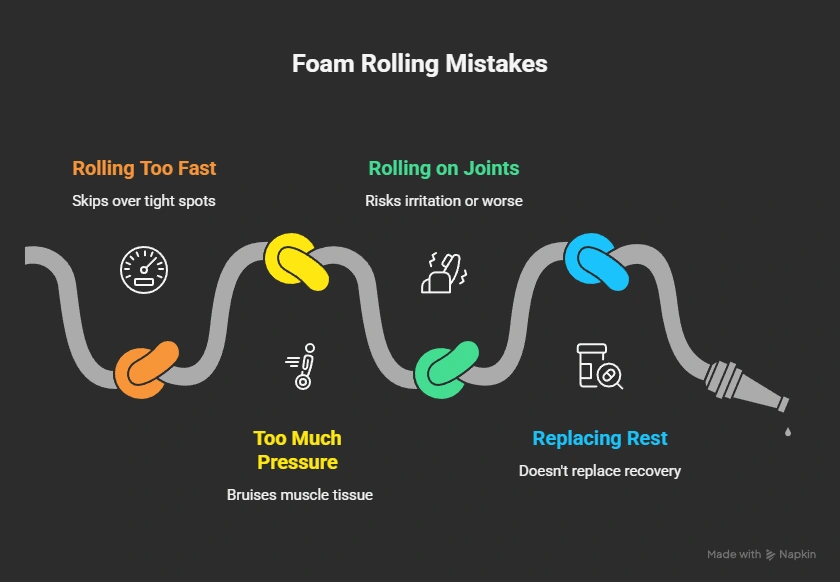
Rolling Too Fast
This is the biggest one. Runners are used to moving fast – it’s literally the sport. But fast rolling skips right over the tight spots that need the most work. Slow way down. When you find a tender area, sit on it for 10-20 seconds. Let the muscle release. That pause is where the real benefit lives.
Using Too Much Pressure
There’s a stubborn myth that foam rolling should hurt. That if it doesn’t feel awful, it’s not working. Not true. Pressing too hard can actually bruise muscle tissue and leave you more sore than when you started.
I once watched a teammate put all his bodyweight onto a hard roller on his first try. He could barely walk the next day. He thought the roller “didn’t work.” Really, he just went way too aggressive. Start lighter than feels natural. You can always add more pressure. Taking away a bruise is harder.
Rolling Directly on Joints or Sharp Pain
Knees, ankle bones, and your lower spine have no muscle cushion to protect them. Rolling directly on these areas risks irritation or worse.
And if you feel a sudden sharp, stabbing pain anywhere – muscle or otherwise – stop immediately. That kind of pain is your body’s alarm system. Listen to it.
Using a Roller Instead of Rest
A foam roller supports recovery. It does not replace it. If your legs feel wrecked after every single run, the problem probably isn’t that you need to roll more. It’s more likely your training plan needs adjusting, or you need more sleep, or both.
Rolling is one ingredient in recovery. Not the whole recipe.
Foam Roller vs Other Running Recovery Gear
Foam rollers get a lot of attention, but they’re hardly the only recovery tool on the market. So how do they stack up against the alternatives?
Foam Roller vs Massage Gun
A foam roller for sore legs covers larger muscle areas efficiently. It costs less and runs on zero electricity. You control the pressure naturally through body positioning.
A massage gun zeroes in on smaller, specific trouble spots. It’s excellent for stubborn knots and trigger points. The catch? Quality massage guns run $100-$300 or more, and cheaper ones often aren’t worth the money.
The practical reality: a foam roller handles the broad strokes. A massage gun handles the detail work. A lot of runners end up owning both eventually, but if you’re choosing one first, the roller gives you more coverage for less money.
Check out: 7 Key Gun Massage Benefits for Running Recovery
Foam Roller vs Compression Gear
A foam roller is an active tool. You use it, put it away, and go about your day. It works by pressing directly into muscle tissue.
Compression socks or boots work passively. You wear them during or after exercise, and they provide gentle, steady pressure around your lower legs. They may help with swelling and circulation.
These tools play completely different roles. Using both in the same recovery routine makes a lot of sense.
Check out: How to Choose Compression Boots for Athletes: Key Features Explained
Foam Roller vs Stretching
Both foam rolling and stretching improve flexibility, but through different mechanisms. Rolling applies direct mechanical pressure to muscle tissue. Stretching lengthens muscles through held positions and controlled movement.
They work better together than either one alone. Many running coaches suggest foam rolling first to relax tight areas, then stretching to lock in those range-of-motion gains. Think of rolling as loosening the knot and stretching as smoothing everything out.
Best First Recovery Tool for Most Runners
If your budget says “pick one,” a medium-density foam roller is almost always the answer. Lowest cost, broadest application, zero learning curve, and almost zero maintenance. It handles calves, quads, hamstrings, glutes, and more in a single tool. Hard to argue with that kind of versatility.
How to Build a Simple Post-Run Recovery Routine
Foam rolling works best when it’s part of a bigger picture. You don’t need a complicated protocol. These two routines cover most situations.
5-Minute Easy Routine (After a Run)
- Walk for 2-3 minutes to let your heart rate come down naturally.
- Drink water. Before you do anything else, rehydrate.
- Foam roll calves, quads, and hamstrings. About 30-60 seconds for each area.
- Stretch lightly. Hold each stretch for 20-30 seconds. Nothing aggressive.
- Eat a recovery snack with both carbs and protein within about 30-45 minutes of finishing.

This routine is intentionally short. I’ve learned from experience that complicated 20-minute recovery protocols rarely survive real life. Five minutes is realistic. Five minutes actually gets done.
Rest Day Routine
- Take an easy walk or gentle bike ride for 15-20 minutes. Keep it truly easy.
- Foam roll with lighter pressure than you’d use after a hard run.
- Spend 5 minutes on basic mobility work – ankle circles, hip openers, leg swings.
- Prioritize extra sleep. This is when your body does its deepest repair work.
Rest days are for letting your body catch up. Approach foam rolling on these days gently – think “maintenance” rather than “treatment.”
When to Skip Foam Rolling
Sometimes the smartest thing to do is nothing at all. Skip the roller if you notice:
- Sharp pain in any muscle or joint.
- Visible swelling in or around muscles.
- A suspected strain or stress injury. Rolling on damaged tissue often makes things worse.
- Skin irritation, open wounds, or fresh bruising in the area you’d normally roll.
When in doubt about whether your soreness is normal or something more concerning, check in with a doctor or physical therapist. Those situations need caution, not more pressure. Mayo Clinic outlines common muscle strain symptoms here.
FAQ
Does a foam roller help sore legs after running?
Yes. Rolling can reduce tightness and help your legs feel less stiff, particularly in the calves, quads, and hamstrings. You’ll notice more benefit if you roll consistently over time rather than just once when your legs feel terrible.
What density foam roller is best for sore legs?
Medium density works best for most runners. It balances effective pressure with reasonable comfort. Go softer if you’re brand new to rolling or extremely sore. Go firmer if you’ve been rolling for a while and want deeper work.
Should I use a foam roller before or after running?
You can do both, with slightly different approaches. Quick, light rolling before a run helps your muscles feel more ready. Slower, more deliberate rolling after a run focuses on recovery and loosening tight spots.
How long should I foam roll sore legs?
About 30-60 seconds per muscle group does the trick. A full lower-body pass takes around 5-10 minutes. You genuinely don’t need to roll for half an hour to get results.
Can I foam roll every day?
Yes, most runners can roll daily without any issues. Just keep the pressure reasonable and skip any area that produces sharp pain. Many coaches actively encourage daily rolling during heavy training blocks.
Is a textured foam roller for sore legs better than a smooth one?
It depends on the person. Smooth rollers feel gentler and work well for beginners or very sore legs. Textured rollers deliver more focused pressure and feel more intense. Neither is objectively “better” – it comes down to your preference and current soreness level.
Can foam rolling prevent running injuries?
It can play a supporting role, but don’t count on it alone. Foam rolling supports mobility and recovery, which can contribute to lower injury risk. But it’s no substitute for smart training, adequate rest, proper strength work, and listening to your body.
Conclusion on foam roller for sore legs
For the majority of runners out there, a medium-density, smooth foam roller is the safest and most practical starting point. It handles sore calves, tight quads, and stiff hamstrings without demanding expertise or emptying your wallet.
When you’re making your choice, come back to three questions: How sore do your legs typically get? Which areas bother you most? And how much do you actually run? A first-time 10K runner and a marathoner logging 60-mile weeks have genuinely different needs.
Use this guide to find the best foam roller for sore legs that matches your body, your budget, and your training life. Then pick one before your next run and give it a real try for a few weeks. Your legs will tell you whether it was worth it – and chances are very good that they will.