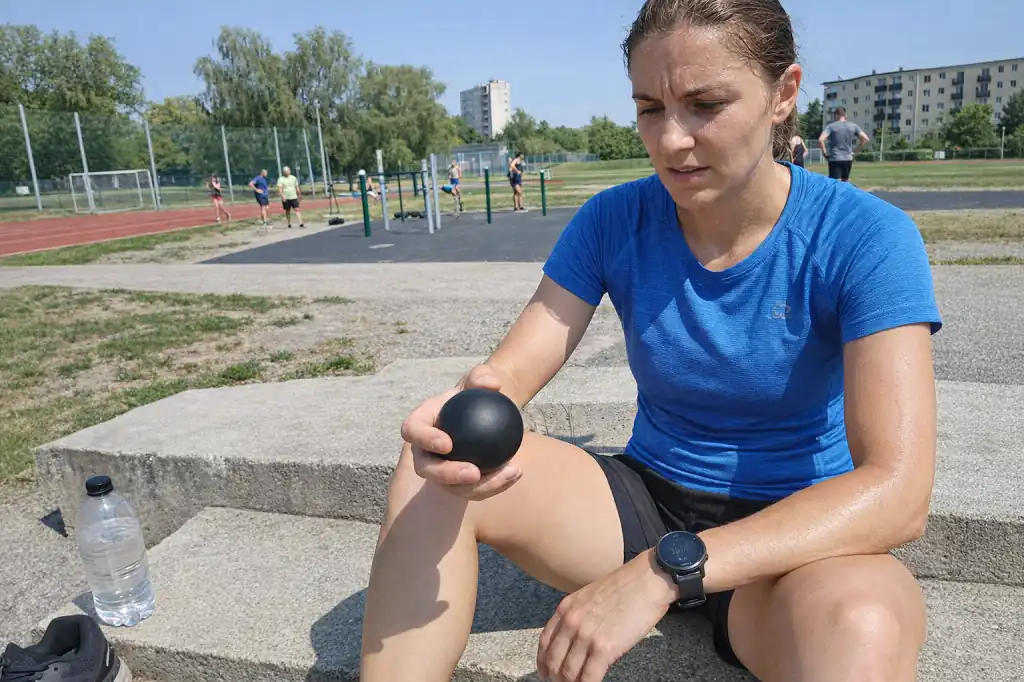
How to use massage ball tools for recovery sounds simple, but a lot of runners do it wrong. They roll too fast, press down too hard, or go after the sore spot like they are trying to hurt it.
A good massage ball session should feel targeted, controlled, and helpful. It should feel like you are working on the problem. It should not feel like you are fighting your body.
If you have ever finished a run with tight calves, a sore arch, or glutes that feel stuck together, a massage ball can really help. It can get into spots that a foam roller often misses. It is also easy to carry, which matters if you travel, race, or run in different places.
I like massage balls because they reward patience. After a hard hill workout, taking five slow breaths on one tight spot in my calf often helps more than two minutes of random rolling.
What you will learn in this guide:
- Why massage balls help runners
- Which type of massage ball to buy
- How to use a massage ball step by step
- How to use a peanut massage ball safely
- How to use a spiky massage ball for feet and warm-up
- When to use a massage ball before or after running
- What mistakes to avoid
Research on self-myofascial release suggests it may help range of motion and reduce the feeling of tightness after exercise.
Study on self-myofascial release and range of motion
Why Every Runner Needs a Massage Ball
A massage ball helps you put pressure on one exact area. That matters when the problem sits in one stubborn spot.
Think about the arch of your foot, the outside of your hip, or the edge of your shoulder blade. A foam roller often glides over those areas. A ball can actually settle into them.
People often call this myofascial release. The phrase sounds technical, but the idea is simple. You put pressure on tight tissue so it can relax.
Runners like to keep a massage ball in their bag because:
- It can find deep muscle knots
- It may improve blood flow to the area
- It can reduce that heavy-leg feeling
- It helps you move better before or after a run
- It is small and easy to carry
One thing is worth clearing up. A lot of runners still think next-day soreness comes from lactic acid. That is not the full story. Lactate clears fairly quickly after exercise. The soreness you feel the next day usually comes more from muscle stress and inflammation, often called DOMS.
So no, a massage ball does not magically remove old lactic acid. What it can do is help you feel looser, move better, and recover more comfortably.
How to Use a Massage Ball Safely Before You Roll
Before you start, follow these three rules.
1. Start with pressure that feels manageable
Aim for good pain, not sharp pain. On a scale from 1 to 10, stay around 5 to 7.
If you tense up, hold your breath, or wince, back off.
2. Move slowly
Rolling fast looks active, but it usually misses the point. Slow pressure helps you find the area that actually needs work.
3. Avoid bones, joints, and already irritated spots
Do not roll directly over:
- Your kneecap
- Your shin bone
- Your spine with a single ball
- The front of your neck
- Any bruised or swollen area
If pain feels sharp, electric, or causes numbness, stop.
If an injury keeps bothering you, talk to a doctor or physical therapist.
The 3 Main Types of Massage Balls
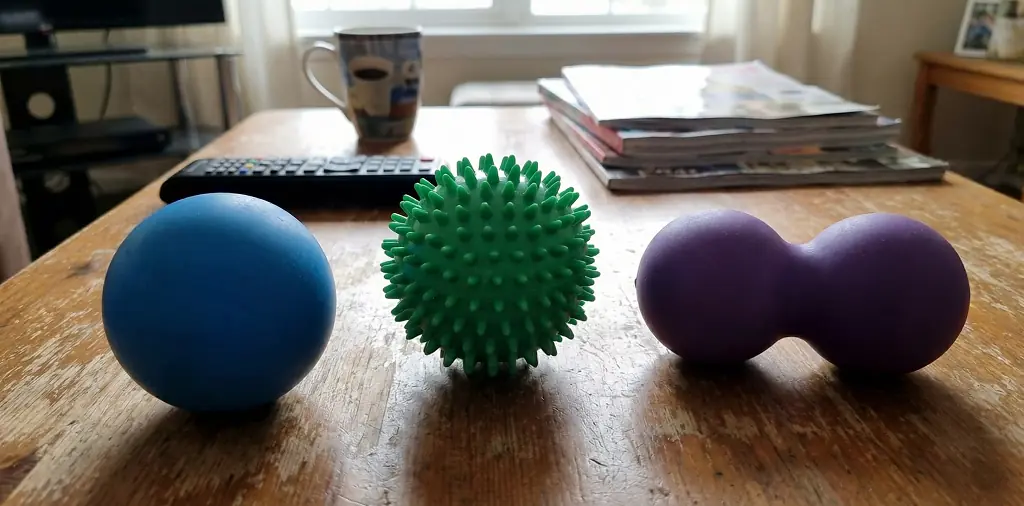
If you are only going to buy one, I would start with a firm, smooth massage ball. It gives you the best mix of depth, control, and value.
Standard Smooth Massage Balls
These are the classic dense rubber balls, often similar to lacrosse balls.
Best for:
- General recovery
- Glutes
- Calves
- Hamstrings
- Upper back against a wall
Pros:
- Strong pressure
- Long-lasting
- Affordable
- Easy to clean
Cons:
- Can feel intense for beginners
- Not ideal along the spine
Peanut Massage Balls
A peanut ball looks like two balls joined together. The dip in the middle gives your spine space.
Best for:
- Upper back
- Lower back muscles beside the spine
- Base of the neck
- Travel recovery
Pros:
- Safer around the spine
- Great for posture tension
- Stable on a wall or floor
Cons:
- Not great for feet
- Less versatile than a single ball
Spiky Massage Balls
These have small rubber spikes on the surface. They usually do not go as deep as smooth balls.
Best for:
- Foot arches
- Pre-run warm-up
- Surface-level stimulation
- Sensitive legs
Pros:
- Feels lively, not brutally deep
- Great for waking up tired feet
- Useful before a run
Cons:
- Less effective on deep knots
- Cheap ones can feel gimmicky
Step-by-Step: How to Use Massage Ball for Recovery
Use the ball on one area at a time. Spend about 30 to 90 seconds on each spot. Breathe slowly. If you find a knot, pause and let the pressure sink in.
1. Roll Out Your Feet
If your feet feel stiff after a run, start here.
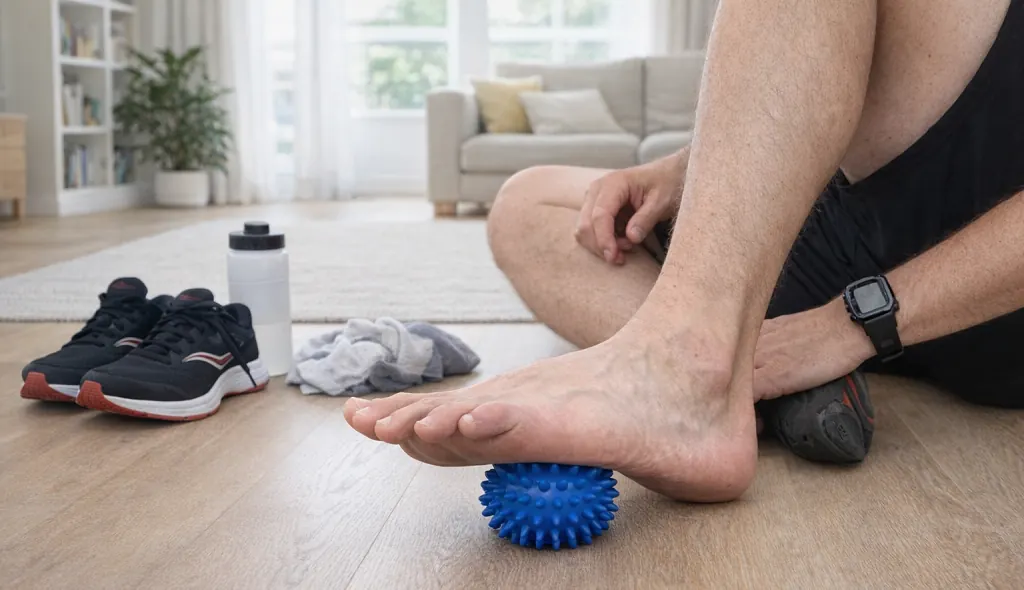
Stand up or sit in a chair. Put the ball under your arch. Roll from your heel toward the ball of your foot.
Slow down when you hit a tender spot. Pause there for 20 to 30 seconds. Then keep moving.
Do this for 60 seconds per foot.
This often feels helpful if your arch gets tight after longer runs. It can also help you with plantar fasciitis.
Tip: Keep the pressure moderate. You do not need to crush your foot to help it.
2. Release Tight Calves and Achilles
Sit on the floor with your legs out. Place the ball under one calf.
Lift your hips slightly with your hands. Let some body weight sink into the ball. Roll slowly from above the Achilles to below the back of the knee.
When you find a hot spot, stop. Hold for 20 to 30 seconds. Take slow breaths.
If you want more pressure, cross the other leg on top. If you want less, keep more weight in your hands.
I use this after speed sessions. Tight calves can make every step feel short and choppy.
3. Loosen Stiff Hamstrings and Glutes
Sit on the floor or on a mat. Put the ball under one glute.
Lean into the side that feels tight. Roll a few inches at a time. If you find a knot, stay there and breathe.
For hamstrings, place the ball under the back of the thigh and support yourself with your hands.
Glutes usually respond better to holds than aggressive rolling. Stay on a tender point for 30 seconds, then shift slightly.
If you run a lot of hills, this area often needs attention.
4. Relieve Upper Back Posture Tension
Stand against a wall. Place the ball between your upper back and the wall.
Keep the ball inside the shoulder blade area. Bend and straighten your knees to roll up and down.
This works well after desk time, long drives, or travel days.
Do not place a single ball directly on the spine. Stay beside it.
How to Use a Peanut Massage Ball Safely
If you want to know how to use a peanut massage ball, the key idea is simple. The shape protects the bones in the middle of your back.
That center gap is what makes the peanut ball useful. It lets you work on the muscles next to the spine, not the spine itself.
Upper back with a peanut ball
Lie on the floor or stand against a wall. Place the peanut ball so each side sits beside the spine.
Tuck your chin slightly. If you are on the floor, lift your hips a little. Roll a few inches up and down.
Pause on tight spots for 20 to 30 seconds.
This works especially well after hours at a laptop or a long trip.
Lower back muscles beside the spine
Use less pressure here.
Place the peanut ball above the pelvis and beside the spine. Move slowly and keep the range small.
Do not grind hard into the lower back. If it feels awkward or too intense, stop and switch to your glutes instead. Tight glutes often create low back tension in the first place.
Base of the neck
Lie down with the peanut ball at the base of your skull.
Do not roll much. Just let your head rest on it and breathe for 20 seconds.
This looks simple, but it often feels surprisingly good.
How to Use a Spiky Massage Ball for Blood Flow
If you are wondering how to use a spiky massage ball, think of it as a lighter tool. It does not usually dig as deep. It works better for surface stimulation and warm-up.
The spikes wake up the skin and small nerves. That can make stiff feet or sleepy calves feel more ready to move.
Before a run
Roll the spiky ball under each foot for 30 to 45 seconds.
Then use it lightly on the calves or quads against a wall. Keep the pressure easy.
You should finish feeling more awake, not sore.
After a run
Use the spiky ball gently on sore quads, glutes, or arches.
Keep it short. Think of it as a light flush, not a deep treatment.
This is the option I suggest for runners who hate hard pressure. It is also good on recovery days when the legs feel sensitive.
Massage Ball vs. Foam Roller: Which Is Better?
Neither tool is better all the time. They just do different jobs.
If I want broad pressure on tired quads, I grab a foam roller. If I want to target one stubborn knot in my glute, I reach for a massage ball.
| Feature | Foam Roller | Massage Ball |
|---|---|---|
| Area covered | Broad | Small and targeted |
| Pressure depth | Moderate | Deep and precise |
| Best for | Quads, hamstrings, calves | Feet, glutes, upper back, trigger points |
| Ease of use | Beginner-friendly | Takes more control |
| Portability | Bulky | Pocket-size |
| Spine work | Limited | Peanut ball works better |
| Pre-run use | Good for general warm-up | Great for feet and problem spots |
| Post-run use | Good for larger muscles | Best for focused relief |
My practical advice:
- Choose a foam roller if you want broad recovery work
- Choose a massage ball if you want precision
- Keep both if you run often
Foam Roller for Sore Legs: Complete Guide for Runners
Common Mistakes When Learning How to Use Massage Ball
You roll too fast
This is probably the most common mistake.
If you rush, you skip over the spot that actually needs attention. Slow down and let the ball settle.
You chase pain
More pain does not mean more benefit.
What matters is control. Useful pressure helps. Brutal pressure usually backfires.
You forget to breathe
If you hold your breath, the muscle often stays tense.
Slow breathing helps the body relax into the pressure.
You spend ages on the IT band
Most runners hate this for a reason. It hurts, and it rarely gives much back.
It usually makes more sense to work on the glutes and outer quad instead.
You only use the ball when something hurts
A massage ball works best when you use it regularly, not only in panic mode.
Try 5 minutes after a hard run or 2 minutes before an important session.
Frequently Asked Questions
How often should runners use a massage ball?
Most runners do well with 3 to 6 short sessions each week. You can use it more often on your feet, calves, and glutes if those areas tighten up fast. Keep each session brief. A few focused minutes works better than one long, painful session.
Should I use a massage ball before or after running?
Use it before running for a quick warm-up on your feet, calves, or hips. Use it after running for slower, more focused work on tight spots. Save deep pressure for post-run or rest days, not right before a fast session.
Does using a massage ball hurt?
It can feel intense, but it should not feel sharp or alarming. You want pressure, not panic. If you feel numbness, sharp pain, or strong tension through the whole body, stop. Good massage ball work should feel like it is helping.
How long should I hold a massage ball on a muscle knot?
Hold the pressure on a knot for 20 to 30 seconds. Then move slightly and repeat if needed. Some spots may need 45 seconds, but longer is not always better. Once the area softens, move on.
Can a massage ball help with shin splints?
A massage ball may help the calves and lower leg muscles around the shin feel less tight. It does not fix every cause of shin splints. If pain keeps coming back or gets sharp, get it checked.
Can I use a massage ball on my lower back?
Yes, but be careful. Use light pressure and avoid rolling directly on the spine. A peanut massage ball works better here than a single ball. In many cases, working on the glutes and hips helps the lower back feel better with less risk.
What is the best massage ball for runners?
If you only want one tool, get a firm smooth massage ball. It is the best all-around choice. If your upper back gets tight, choose a peanut ball. If you mainly want foot work or a gentle warm-up, choose a spiky ball.
Conclusion
A massage ball works best when you use it with purpose. Find the tight spot, breathe, hold, and move on. You do not need a long routine. You need a smart one.
If you want to stay consistent, start with your feet, calves, glutes, and upper back. Those areas usually give runners the fastest payoff. Once you learn how to use massage ball tools the right way, recovery feels less random and a lot more effective.